“Reshoring” seemed like a boardroom term for years. According to lease statistics, there is a real need for actual structures in 2026.
India, particularly the Noida, Greater Noida, and Yamuna Expressway (YEIDA) region, is getting an increasing portion of the global manufacturers’ rebalancing of production locations. If you want to purchase, lease, or sell an industrial property, this article explains what is truly going on, what the data indicate, and what it implies.
What Reshoring Actually Means (and Doesn't)
The words are frequently muddled up, therefore here is a clear explanation.
Reshoring: refers to bringing production back to a company’s native country.
China+1: maintaining some capacity in China while establishing at least one more industrial base overseas.
Friend-shoring: means placing production in politically allied partner nations.
Supply chain diversity: an umbrella word that encompasses all of the following.
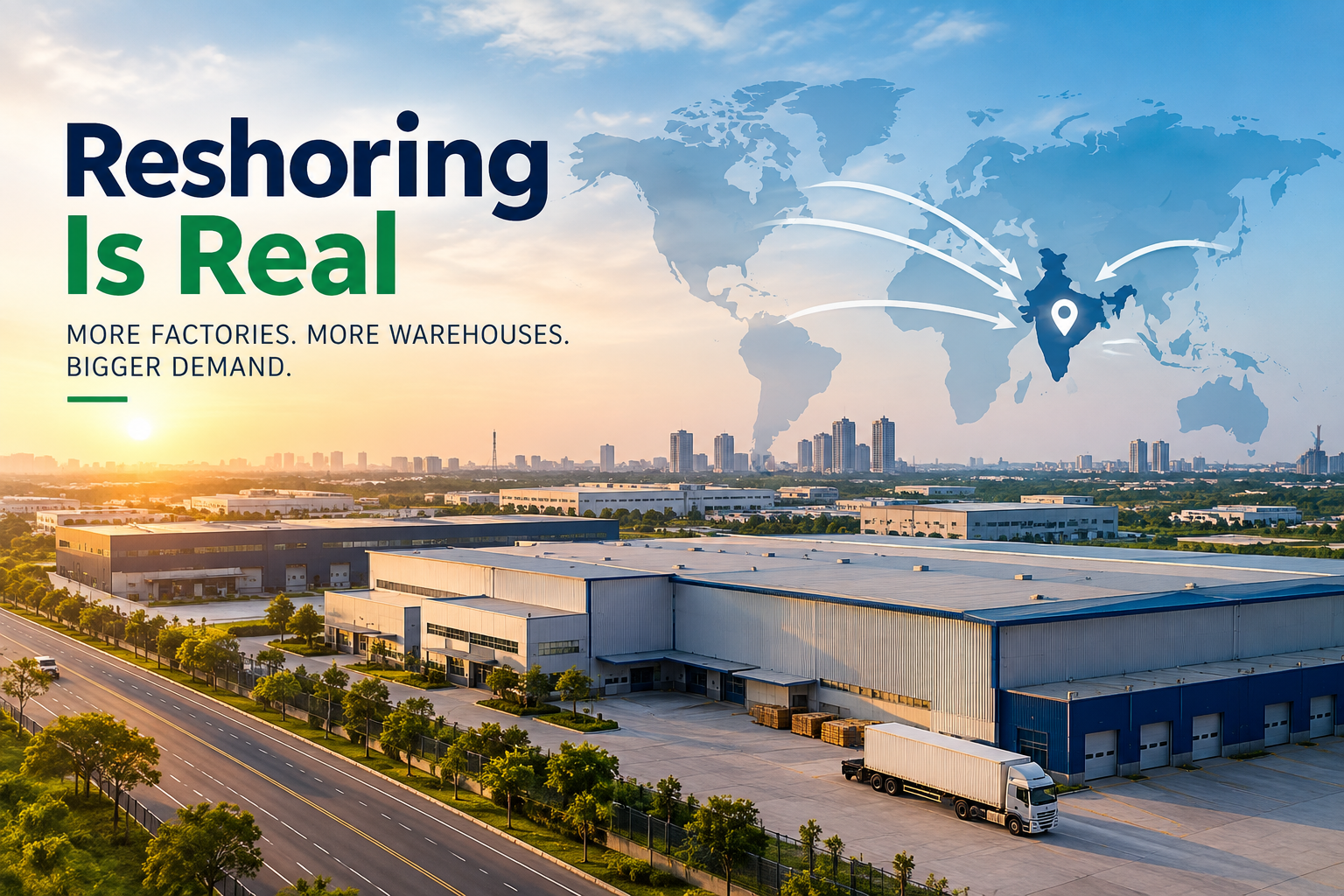
In the literal sense, India is often not a direct benefit of reshoring, because reshoring involves returning manufacturing to the United States or the European Union; nonetheless, India is a prominent “plus-one” destination under China+1 and friend-shoring. When we say “reshoring is driving demand” in India, we actually imply three forces working together:
- Global firms are increasing capacity in India as part of China+1.
- Indian firms are localizing components that they used to import.
- Government-backed manufacturing programs include PLI, electronics component schemes, and semiconductor projects.
All three require one thing in common:
production and warehousing space.
The Numbers: Manufacturing is Filling Industrial Space
The first half of 2026 set a record for Indian industrial real estate:
Gross leasing in the top eight cities hit 36.2 million square feet, the most ever recorded for the first half of the year.
Delhi NCR dominated leasing activity, accounting for 24% of the total.
Delhi NCR saw 8 MSF of warehouse leasing, a 66% increase year on year.
According to Knight Frank, manufacturing was the main demand driver, accounting for 46% of overall leasing, or 17 million sq ft, a 17% increase over last year.
Electronics leasing nearly increased year on year to 1.4 million square feet, indicating that demand is shifting outside typical occupiers.
Third-party logistics businesses, together with engineering and manufacturing enterprises, account for substantially more than half of all absorption. Manufacturers are no longer the exclusive tenants of warehouses. They are establishing the necessary supply linkages.
Why India? Why Now?
1. Electronics and the “Apple Effect.” India’s portion of global iPhone production is said to be on course to reach 25-30%, up from less than 10% a few years ago. Even though Apple’s ecosystem accounts for a small portion of India’s overall exports, it has trained a generation of factory operators and engineers in contemporary electronics production, and that expertise is spreading to other purchasers.
2. Tariff and trade uncertainties. Global purchasers are aggressively hedging. According to one sourcing analysis, India’s all-in tariff rate on most categories is between 25-35%, compared to 35-45% for China, however India’s tariff position has shifted multiple times in recent months. Because the restrictions are always changing, corporations want to distribute their manufacturing over many countries.
3. Government-backed industrial zones. YEIDA has announced many specific industrial projects, including a Medical Devices Park and a Data Center Park in Sector 28, a Semiconductor and EMC cluster in Sector 10, Film City in Sector 21, and a logistics park in Tappal. These provide manufacturers with ready ecosystems rather than dispersed plots.
4. Cost and closeness. The Noida-Greater Noida-YEIDA belt boasts road, rail, and expressway connections, a huge trained labor pool, and close to the planned Noida International Airport.
What Does This Mean for Factory and Warehouse Demand in 2026-2027?
The demand for sheds and factories with power, height, and load capacity is increasing. Electronics, automotive components, engineering, and medical items require more than a standard storage. They seek for a sufficient power load, clear-height structures, truck movement space, and suitable industrial-use land.
Ready-to-use industries are moving quicker than undeveloped property. Manufacturers who need to start production fast frequently prefer an existing factory or shed over a two-year development.
As supply catches up in some categories, quality becomes increasingly important. Approximately 25 million square feet of additional Grade A warehouse space were constructed nationally, exceeding leasing demand. Despite this, national vacancy declined to 11.4%, while NCR rentals climbed 5%. Well-located, well-documented properties retain value, but poorer assets require more negotiation.
The location will determine the winners. Noida isn’t the sole NCR logistics hotspot. Gurgaon, Farukhnagar, and Ghaziabad developed as key logistics hubs as a result of large-format transactions. Noida and Greater Noida compete most effectively when production, rather than storage, is the primary use case.
A realistic perspective: challenges remain.
Reshoring and China+1: are genuine, but they are not guaranties for all properties. Buyers and investors should bear the following in mind:
Infrastructure gaps: India’s ports and last-mile logistics still lag behind China’s, but industrial corridors and SEZs are closing the gap.
Policy volatility: Tariffs and trade restrictions can change rapidly, so long-term choices should not be based on a single headline.
Title, land-use, and authority-compliance risks: the incorrect plot with unclear dues, transfer limitations, or use-class issues might cost considerably more than a desirable site.
Pocket oversupply: Not all warehouse micro-markets are as competitive.
What Owners, Investors, and Buyers of Industry Should Do Right Now
If you work as an occupier or manufacturer:
In addition to pricing per square meter, shortlist locations based on authority clearances, power availability, and connection to your suppliers and customers.
Compare leasing, obtaining an allocation from the government, and purchasing a ready-made factory.
If you're an investor:
Pay attention to properties like electronics, engineering, pharmaceuticals, and logistics that have a defined end-user.
Before committing, review the terms of the allotment, the length of the lease, the transfer requirements, and any overdue payments.
If you are a factory or warehouse owner:
Well-documented assets are in a favorable demand cycle right now. A large deal of time can be saved with neat paperwork and proper placement.
The Benefits of Khushi Properties
Khushi Properties is a commercial and industrial real estate consultancy that specializes in the Yamuna Expressway corridor, Noida, and Greater Noida. Our advice is based on your business use case; we are counselors, not builders. We assist manufacturers, investors, and owners in locating, confirming, and closing the ideal industrial property. We have over 25 years of experience and have closed over 650 agreements.
📍 C-65,5 Sector 63, Noida
📞 +91 9810479077
🌐 khushiipropertiies.com
Common Questions
1. What does manufacturing reshoring mean?
Reshoring is the process of returning production from abroad to a company’s home nation. It differs between friend-shoring, when production shifts to politically aligned partners, and China+1, where businesses maintain some production in China and add another nation.
2. Does reshoring actually raise the need for Indian manufacturers and warehouses?
In actuality, friend-shoring and China+1 are more advantageous to India than reshoring. In any case, the demand is genuine. According to Knight Frank’s data, manufacturing was the main driver of demand, and H1 2026 was a record half-year for industrial leasing in India.
3. In 2026, which sectors will be driving demand for industrial space?
Leading industries include electronics, autos, e-commerce, engineering and manufacturing, and third-party logistics. In H1 2026, electronics leasing almost doubled year over year.
4. Why are producers considering YEIDA, Noida, and Greater Noida?
The belt provides access to a big labor pool, planned industrial parks, close proximity to the future Noida International Airport, and train and road connectivity. Projects including medical devices, data centers, semiconductors and electronics, and logistics have been notified by YEIDA.
5. What kinds of industrial real estate are in high demand?
Manufacturers are in high demand for Grade A warehouses for logistics as well as ready factories and sheds with sufficient power load and truck movement space. Businesses who wish to construct to their own specifications are well suited for industrial plots in authority-developed sectors.
6. Is now a good time to buy industrial real estate in Noida?
Although there are good demand indicators, investing should be based on the particular property, its location, its end-use possibilities, and its title and dues status. Fundamentals are more important than headlines because some warehouse categories are witnessing fresh supply.
7. What should I look at before purchasing an industrial site or factory in Noida?
Examine the lease deed and allocation letter, any unpaid bills with the relevant authorities, approvals for transfers and mortgages, authorized land usage, allowed layout, electricity load, and access. The most frequent and costly issues are avoided by confirming these before committing.
8. Do rents and prices for industrial real estate in the NCR continue to rise?
Knight Frank reports that national vacancy dropped to 11.4% and NCR warehouse rents increased by almost 5% in H1 2026. Before making a choice, examine similar properties because rates still differ by micro-market, condition, and use.
9. Do I need to purchase, rent, or accept an authority allotment?
Your timeline and financial resources will determine this. Leasing allows for capital flexibility, authority allotments are appropriate for long-term custom constructions, and purchasing a ready factory is typically the quickest option. A consultant can evaluate these choices based on your particular needs.
10. How can I locate an industrial property with Khushi Properties' assistance?
Khushi Properties provides shortlisting, verification, and closing assistance for industrial plots, factories, warehouses, and sheds in Noida, Greater Noida, and YEIDA. You can visit the office at C-65, Sector 63, Noida, or give +91 9810479077 a call.
 Factory Spaces