
 Factory Spaces
Leasing commercial or industrial property in Noida involves several legal, financial, and regulatory steps. Whether you are looking for office space, a warehouse, factory unit, or industrial building, this guide walks you through the complete process — from defining your requirements to moving in.

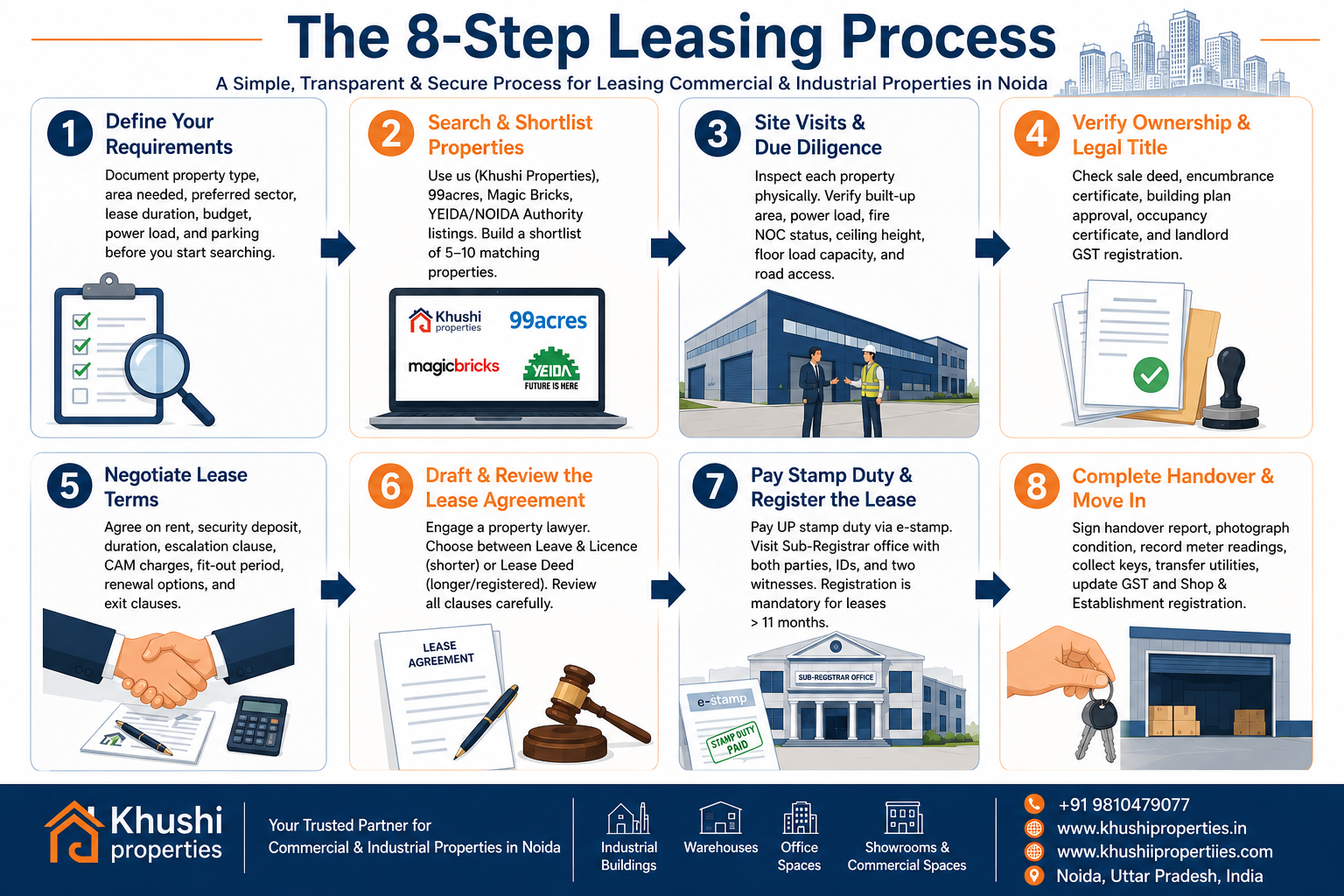
The 8-Step Leasing Process
1. Define Your Requirements
Document property type, area needed, preferred sector, lease duration, budget, power load, and parking before you start searching.
2. Search & Shortlist Properties
Use us Khushi properties, 99acres, Magic Bricks, YEIDA/NOIDA Authority listings. Build a shortlist of 5–10 matching properties.
3. Site Visits & Due Diligence
Inspect each property physically. Verify built-up area, power load, fire NOC status, ceiling height, floor load capacity, and road access.
4. Verify Ownership & Legal Title
Check sale deed, encumbrance certificate, building plan approval, occupancy certificate, and landlord GST registration.
5. Negotiate Lease Terms
Agree on rent, security deposit, duration, escalation clause, CAM charges, fit-out period, renewal options, and exit clauses.
6. Draft & Review the Lease Agreement
Engage a property lawyer. Choose between Leave & Licence (shorter) or Lease Deed (longer/registered). Review all clauses carefully.
7. Pay Stamp Duty & Register the Lease
Pay UP stamp duty via e-stamp. Visit Sub-Registrar office with both parties, IDs, and two witnesses. Registration is mandatory for leases > 11 months.
8. Complete Handover & Move In
Sign handover report, photograph condition, record meter readings, collect keys, transfer utilities, update GST and Shop & Establishment registration.
Step-by-Step Checklist
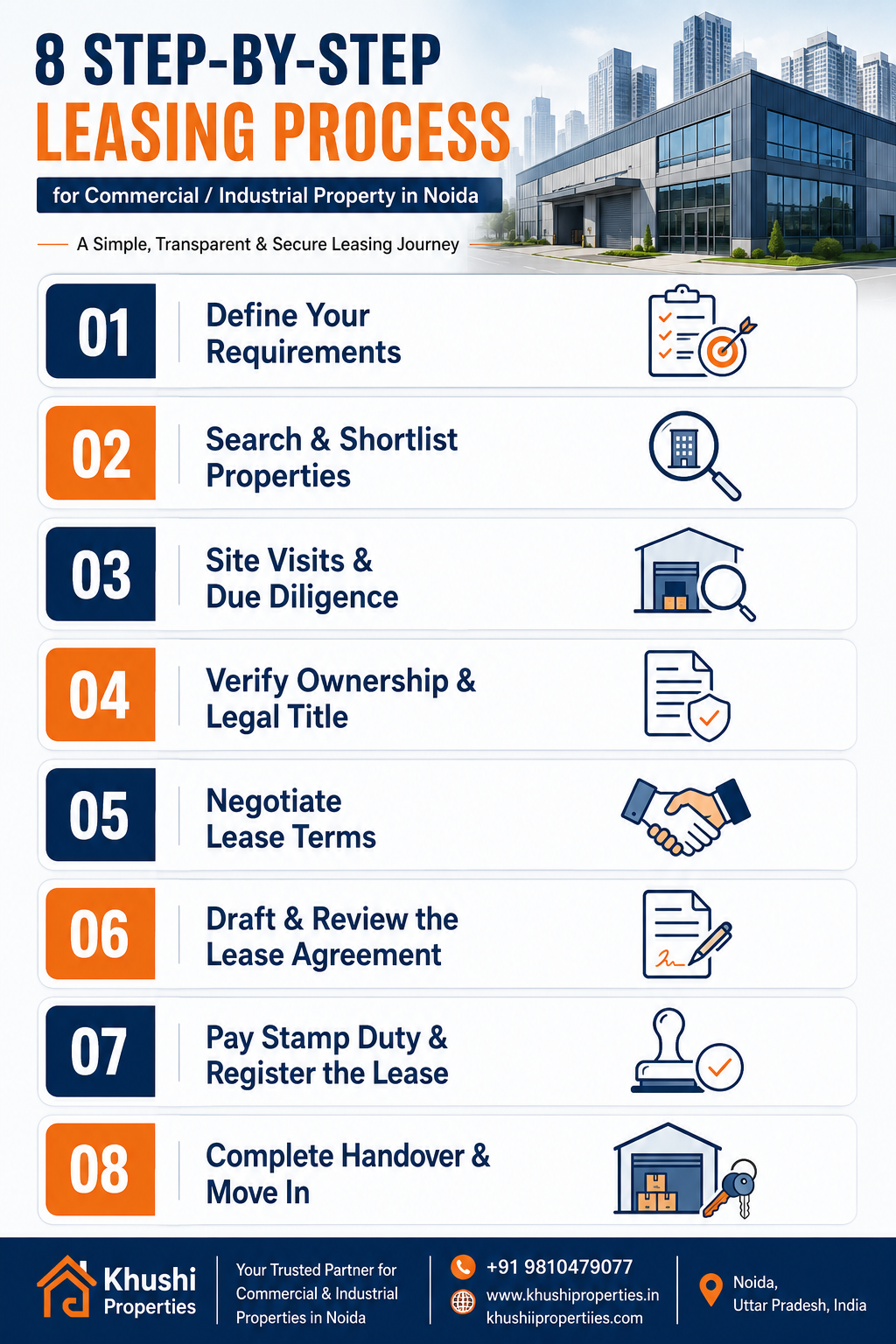
Step 1: Define Your Requirements
Step 2: Search & Shortlist Properties
Step 3: Site Visits & Due Diligence
Step 4: Verify Ownership & Legal Title
Step 5: Negotiate Lease Terms
Step 6: Draft & Review the Lease Agreement
Step 7: Pay Stamp Duty & Register the Lease
Step 8: Complete Handover & Move In
Documents Checklist (Tenant Side)
Ensure you have these documents ready before signing:
Frequently Asked Questions (FAQ)
Q: Is it mandatory to register a commercial lease in Noida?
A: Yes. Under the Registration Act 1908, any lease exceeding 11 months must be compulsorily registered at the Sub-Registrar’s office. An unregistered lease agreement is not admissible as evidence in court in the event of a dispute. It is strongly advised to register even short-term leases for legal protection.
Q: What is the difference between a Leave & Licence Agreement and a Lease Deed?
A: A Leave & Licence Agreement grants the licensee temporary permission to use the property and is easier to terminate. It is typically used for shorter durations. A Lease Deed creates a transfer of interest in the property for the tenant (lessee) and offers stronger tenancy rights. For commercial and industrial properties in Noida, a registered Lease Deed is more common for longer terms.
Q: How much stamp duty is payable for a commercial lease in Noida?
A: Stamp duty in Uttar Pradesh is levied as a percentage of the total lease consideration (rent + security deposit). The rate is approximately 2% for leases up to 1 year, and higher for longer-term leases. Exact rates depend on the lease duration and type of property. Always verify current rates at the official UP stamp duty portal igrsup.gov.in before executing the agreement.
Q: What is a typical security deposit for commercial property in Noida?
A: Security deposits for commercial and industrial properties in Noida typically range from 2 to 6 months of monthly rent, depending on the property type and landlord terms. Industrial and warehouse properties commonly attract 3 months, while premium office spaces may require up to 6 months. The deposit is refundable at the end of the lease after deduction for any dues or damages.
Q: Can a tenant sub-let a commercial property in Noida?
A: Sub-letting is only permitted if it is expressly allowed in the lease or Leave & Licence agreement. Most commercial leases in Noida restrict or prohibit sub-letting without the landlord’s prior written consent. Additionally, if the property is held on leasehold from NOIDA Authority, the original allottee may face restrictions on sub-letting under their allotment terms.
Q: Which sectors in Noida are best for industrial and warehouse leasing?
A: In 2026, Sector 63, 64, and 65 are prime locations for industrial buildings and manufacturing units due to their established infrastructure and proximity to Delhi. Sector 80, 81, and 83 are popular for warehousing and logistics due to their highway connectivity and large available floor plates. For commercial office space, Sector 18, 62, 125, and 135 remain the most sought-after locations.
Q: What licences and registrations are required after leasing an industrial property?
A: After taking possession of an industrial or manufacturing unit in Noida, you typically need to apply for a Trade Licence from the local authority, Factory Licence under the Factories Act 1948 (if applicable), Consent to Establish from UPPCB (Uttar Pradesh Pollution Control Board), Udyam Registration, and update your GST and Shop & Establishment registrations to reflect the new address. These must generally be obtained within 30 days of commencement of operations.
Q: How long does the commercial leasing process take in Noida?
A: The end-to-end leasing process in Noida typically takes between 4 and 12 weeks, depending on the complexity of the transaction and how quickly the parties complete legal verification and negotiations. Straightforward transactions with clear title and pre-agreed terms can close in 4–6 weeks. Larger or more complex deals involving NOIDA Authority approvals or significant fit-out requirements may take longer.
Q: Are GST charges applicable on commercial rent in Noida?
A: Yes. GST at 18% is applicable on commercial property rent in India, including Noida. If the landlord is GST registered and the annual rental income exceeds the GST threshold, GST will be charged on the monthly rent. As a registered business tenant, you can typically claim input tax credit on the GST paid on rent, subject to your applicable business category.
Q: What should be included in the property handover report?
A: The handover report should document the current condition of the premises including flooring, walls, ceiling, electrical fittings, sanitary installations, locks, shutters, and any existing fixtures. It should note the meter readings for electricity and water, a list of all keys and access cards handed over, any existing defects or damage agreed as pre-existing, and be signed by both the landlord and tenant with the date of handover.